

Dental implants have long been considered the gold standard for tooth replacement due to their durability and natural feel. However, they are not the right choice for everyone. High costs, the need for surgery, sufficient jawbone density, healing time, or certain medical conditions can make implants impractical or undesirable.
If you’re searching for alternatives to dental implants, you’re not alone. Many patients seek effective, less invasive, and more affordable options to restore their smile, chewing function, speech, and facial structure. This comprehensive guide explores the best alternatives available in 2026, including their procedures, pros, cons, costs, longevity, and ideal use cases. We’ll also provide a detailed comparison to help you make an informed decision.
Why Look for Alternatives to Dental Implants?
Dental implants require a surgical procedure where a titanium post is placed into the jawbone, followed by months of osseointegration (bone fusion). The total process can take 3–12 months, with costs often ranging from $3,000–$6,000+ per tooth. Not everyone qualifies due to bone loss, smoking, diabetes, or budget constraints.
Alternatives offer:
- No or minimal surgery
- Faster results (often within weeks)
- Lower upfront costs
- Solutions for patients with insufficient bone density
- Good aesthetics and function for daily life
The best option depends on the number of missing teeth, location (front vs. back), oral health, budget, and personal preferences. A thorough consultation with a restorative dentist, including X-rays or 3D scans, is essential.
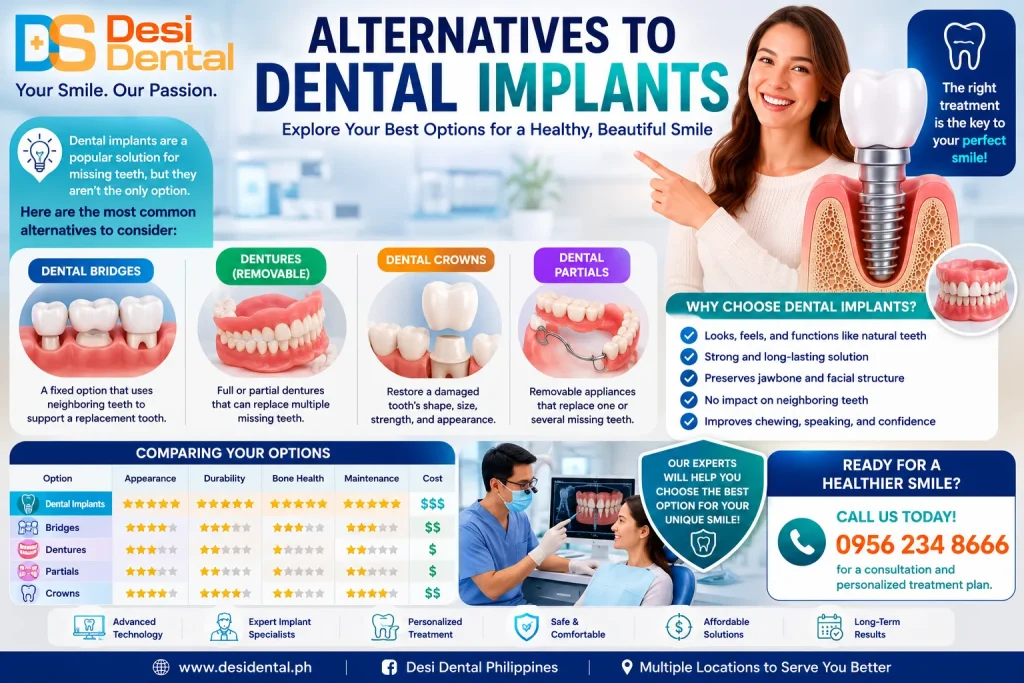
5 Best Alternatives to Dental Implants
1. Dental Bridges (Traditional Fixed Bridges)
Dental bridges are one of the most popular alternatives to dental implants. They consist of artificial teeth (pontics) anchored by crowns on adjacent natural teeth.
Procedure:
- The dentist prepares (shapes) the abutment teeth.
- Impressions or digital scans are taken.
- A custom bridge is fabricated (porcelain, zirconia, or metal-fused).
- The bridge is cemented in place, usually in 2–3 visits over 1–3 weeks.
Pros:
- Fixed and stable — feels like natural teeth
- Quick completion compared to implants
- Excellent aesthetics with modern materials
- Restores bite force effectively for 1–3 missing teeth in a row
Cons:
- Requires altering healthy adjacent teeth (enamel removal)
- Does not prevent jawbone loss under the missing tooth
- May need replacement every 5–15 years
- Risk of decay or issues with supporting teeth over time
Cost (2026 estimates): $2,000–$5,000 per bridge (3 units), depending on materials and location. Often partially covered by insurance.
Best for: One to three consecutive missing teeth with strong neighboring teeth.
2. Maryland Bridges (Resin-Bonded Bridges)
A more conservative version of bridges, Maryland bridges use metal or ceramic “wings” bonded to the back of adjacent teeth with minimal or no tooth preparation.
Pros: Highly tooth-preserving, reversible, faster, and more affordable. Ideal for front teeth where biting pressure is lower.
Cons: Less durable for back teeth; wings may debond over time (lasting 5–10+ years with care).
Cost: Generally lower than traditional bridges.
3. Partial Dentures
Partial dentures replace multiple missing teeth while preserving remaining natural teeth. They feature replacement teeth on a gum-colored acrylic or flexible base, secured with clasps, precision attachments, or suction.
Types:
- Traditional cast metal framework (strong but visible clasps)
- Flexible partials (Valplast or similar — more comfortable and aesthetic)
- Acrylic partials (lighter, often temporary)
Procedure: Impressions taken, several fitting appointments for adjustments. Can be ready in 2–6 weeks.
Pros:
- Non-invasive — no surgery or tooth alteration
- Affordable and adjustable
- Easy to repair or modify as needs change
- Good for multiple missing teeth across the arch
Cons:
- Removable (must take out nightly)
- Can feel bulky at first; may affect speech or taste temporarily
- Less stable than fixed options
- Potential gum irritation or bone resorption over time
Cost: $300–$2,500 depending on type and extent. Very budget-friendly.
Longevity: 5–10 years with proper care and adjustments.
4. Complete (Full) Dentures
For patients missing all or nearly all teeth in one or both jaws, complete dentures provide a full-arch restoration.
Modern advancements (2026):
- Better materials for natural appearance and comfort
- Digital dentures with improved fit via 3D printing
- Hybrid options like snap-in dentures (overdentures) that attach to 2–4 mini or standard implants for superior stability without full implant replacement.
Pros:
- Restore facial support and aesthetics dramatically
- Most affordable full-mouth solution
- Non-surgical (except for snap-in variants)
Cons:
- Can slip or cause sore spots
- Reduced chewing efficiency (20–30% of natural teeth)
- Require adhesives and frequent adjustments due to bone changes
Cost: $1,000–$4,000 per arch for traditional; higher for premium or implant-supported.
5. Other Effective Alternatives
- Flipper Teeth (Temporary Partials): Lightweight acrylic removable appliances for 1–few teeth. Excellent as interim solutions during healing or while saving for permanent options. Not for long-term use due to fragility.
- Mini Dental Implants: Smaller-diameter implants (under 3mm) that are less invasive, often placed in one visit, and suitable for stabilizing dentures or bridges when bone is limited. They can serve as a middle-ground option.
- Implant-Supported Bridges or Overdentures: Hybrid solutions using fewer implants for better retention than traditional dentures.
Detailed Comparison Table: Alternatives to Dental Implants
| Option | Invasiveness | Longevity | Approx. Cost (per unit/arch) | Stability & Function | Bone Preservation | Best Candidates |
|---|---|---|---|---|---|---|
| Traditional Bridges | Low (tooth prep) | 5–15 years | $2,000–$5,000 | High | No | 1–3 missing teeth |
| Maryland Bridges | Very Low | 5–10+ years | $1,500–$3,500 | Medium-High | No | Front teeth |
| Partial Dentures | None | 5–10 years | $300–$2,500 | Medium | Minimal | Multiple missing teeth |
| Full Dentures | None | 5–10 years | $1,000–$4,000 per arch | Low-Medium | No | Full arch missing |
| Mini Implants | Medium | 10+ years | $500–$2,000 per implant | High | Yes | Denture stabilization |
| Flipper (Temporary) | None | Short-term | $200–$800 | Low | No | Interim solution |
Frequently Asked Questions (FAQs)
Are alternatives as good as dental implants? They can be highly effective depending on your needs. Implants excel in longevity and bone health, but bridges and well-fitted dentures provide excellent results for many patients.
Will insurance cover alternatives? Bridges and dentures are more commonly covered than implants. Check your plan.
How long do I have to wait for alternatives? Bridges and dentures are usually much faster than implants.
Can I eat normally? Most patients adapt well and regain 70–90%+ of function with proper fitting.
The landscape of alternatives to dental implants in 2026 offers diverse, high-quality solutions that can dramatically improve quality of life without the commitment of full implant surgery. Whether you choose a fixed dental bridge for a natural feel, comfortable partial dentures for flexibility, or a hybrid approach, modern dentistry provides options tailored to your situation.
Don’t delay — untreated missing teeth can lead to more complex issues. Consult an experienced restorative or cosmetic dentist for a personalized evaluation. They can discuss financing, warranties, and show before-and-after examples.


