

When considering tooth replacement options, understanding the different types of dental implants and their costs is essential for making a confident, informed decision. Dental implant prices vary widely depending on the type, materials used, number of implants, geographic location, dentist expertise, and additional procedures like bone grafting.
This comprehensive 2026 guide provides detailed information on the main types of dental implants, their specific uses, advantages, disadvantages, realistic cost ranges in the United States and globally, and factors that influence pricing. The goal is to help you evaluate which option best fits your oral health needs and budget.
Types of Dental Implants
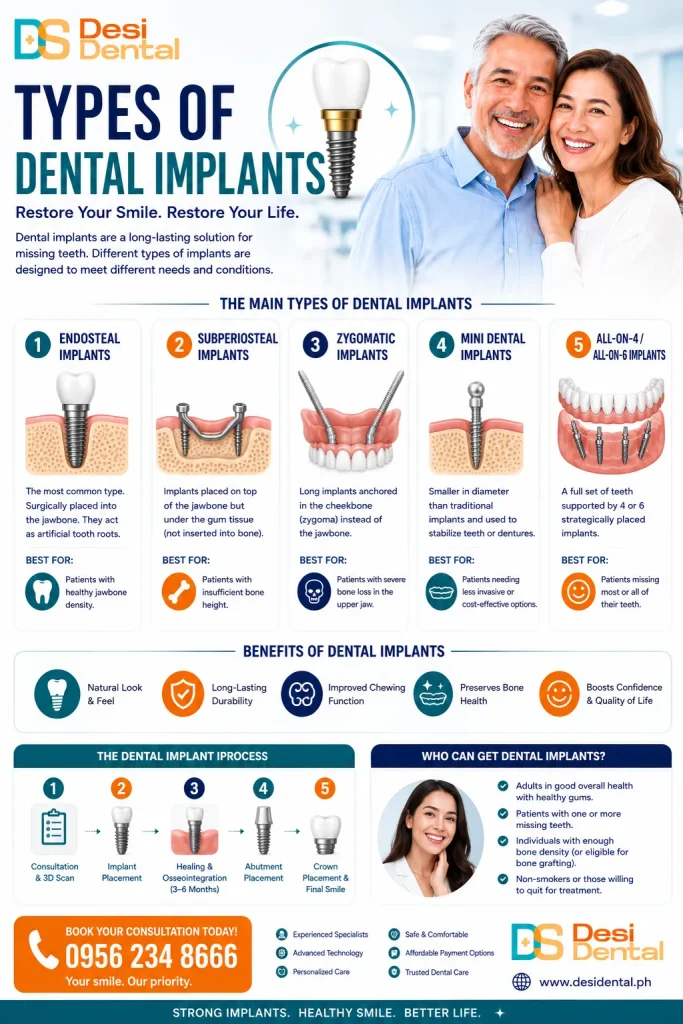
1. Endosteal Implants – The Gold Standard
Endosteal implants are the most common and widely used type of dental implant, representing over 90% of all implant procedures worldwide. These implants are screw-shaped or cylindrical and are surgically placed directly into the jawbone, functioning like natural tooth roots.
Best For:
- Replacing one or several missing teeth
- Supporting dental bridges
- Full arch restorations (All-on-4, All-on-6, or All-on-8)
Procedure Overview: The implant is inserted into the jawbone and allowed to osseointegrate (fuse with bone) over 3–6 months before attaching the abutment and final crown or bridge.
Advantages:
- Highest long-term success rate (95–98%)
- Excellent stability and chewing function
- Natural appearance and feel
- Stimulates jawbone to prevent bone loss
Disadvantages:
- Requires adequate bone volume (bone grafting may be necessary)
- Longer treatment timeline
Cost Breakdown (2026):
- Single tooth (implant + abutment + crown): $3,800 – $7,500
- 3-unit implant bridge: $9,000 – $16,000
- All-on-4 Full Arch: $18,000 – $35,000 per arch
- All-on-6 Full Arch: $22,000 – $40,000 per arch
Premium materials like zirconia crowns or custom abutments can add $1,000–$3,000 per tooth.
2. Subperiosteal Implants
Subperiosteal implants consist of a custom-made metal framework that rests on top of the jawbone but under the gum tissue. Posts protrude through the gums to support the prosthetic teeth.
Best For:
- Patients with significant bone loss who prefer to avoid bone grafting
- Full lower arch restorations in cases of shallow jawbone
Advantages:
- Less invasive surgery compared to bone grafting + endosteal
- Faster placement in suitable candidates
- Suitable for patients who cannot undergo extensive bone procedures
Disadvantages:
- Generally less stable long-term than endosteal implants
- Higher risk of complications over 10+ years
- Less commonly used today due to advances in bone regeneration techniques
Cost Breakdown:
- Full arch subperiosteal restoration: $15,000 – $28,000 per arch
- Typically 15–25% less expensive than equivalent endosteal options
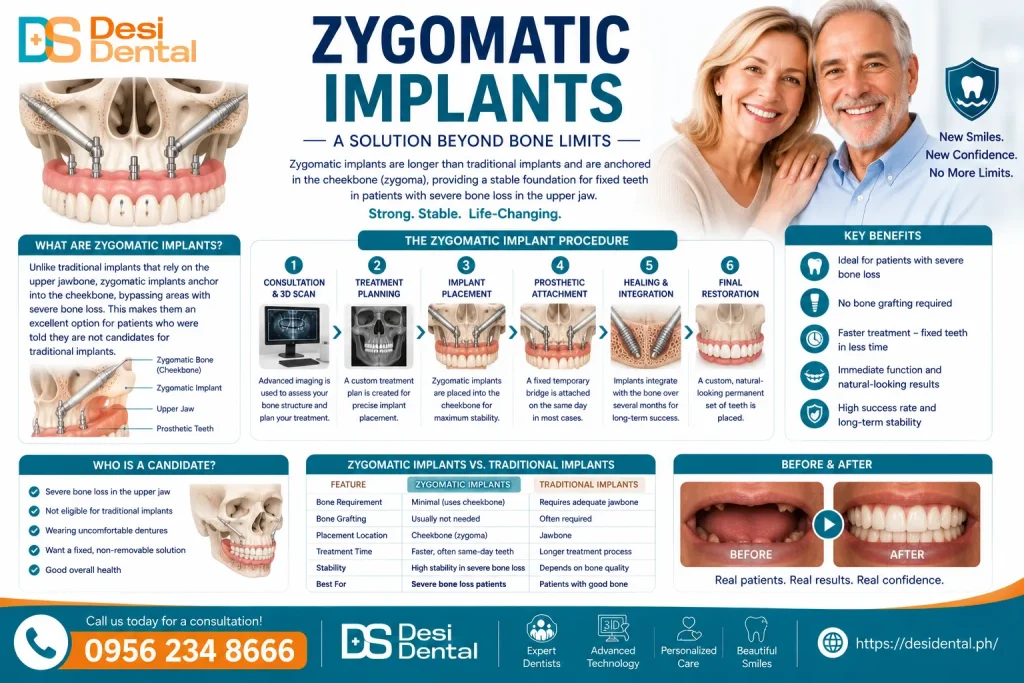
3. Zygomatic Implants
Zygomatic implants are extra-long implants (up to 50–55mm) that anchor into the dense zygomatic (cheek) bone rather than the maxillary jawbone. They are specifically designed for the upper jaw.
Best For:
- Severe bone loss in the upper jaw (maxilla)
- Patients wanting to avoid major sinus lift or bone grafting
- Full upper arch rehabilitation
Advantages:
- Eliminates the need for extensive bone grafting
- Often supports immediate loading (teeth same day)
- High success rate (around 94–96%) when performed by experienced surgeons
Disadvantages:
- More complex and technically demanding surgery
- Limited to upper jaw applications
- Higher surgical skill requirement
Cost Breakdown:
- Full upper arch with zygomatic implants: $25,000 – $45,000
- Hybrid cases (zygomatic + regular implants): $30,000 – $55,000
4. Mini Dental Implants (MDIs)
Mini dental implants have a much smaller diameter (under 3mm) compared to standard implants. They are often used to stabilize dentures or replace small teeth.
Best For:
- Stabilizing loose lower dentures
- Patients with narrow bone ridges
- Temporary solutions or those who cannot undergo standard surgery
Advantages:
- Minimally invasive (often no flap surgery needed)
- Faster procedure and healing time
- Lower overall cost
Disadvantages:
- Lower strength and durability for high biting forces
- Higher long-term failure rate in posterior areas
- Not ideal as a permanent single-tooth solution in high-load zones
Cost Breakdown:
- Single mini implant: $1,000 – $2,800
- 4–6 mini implants for lower denture stabilization: $6,000 – $13,000
Factors That Significantly Affect Dental Implant Costs
- Geographic Location: Costs in major US cities are 20–40% higher than in smaller towns. Dental tourism (Mexico, Turkey, Vietnam, Thailand) can reduce prices by 50–70%.
- Dentist Expertise: Board-certified oral surgeons or prosthodontists charge more but often deliver better outcomes.
- Materials: Titanium vs zirconia, stock vs custom abutments, acrylic vs zirconia prosthetics.
- Additional Procedures: Bone grafting ($500–$3,500 per site), sinus lifts ($1,500–$4,000), extractions, sedation.
- Number of Implants: More implants increase cost but improve long-term stability.
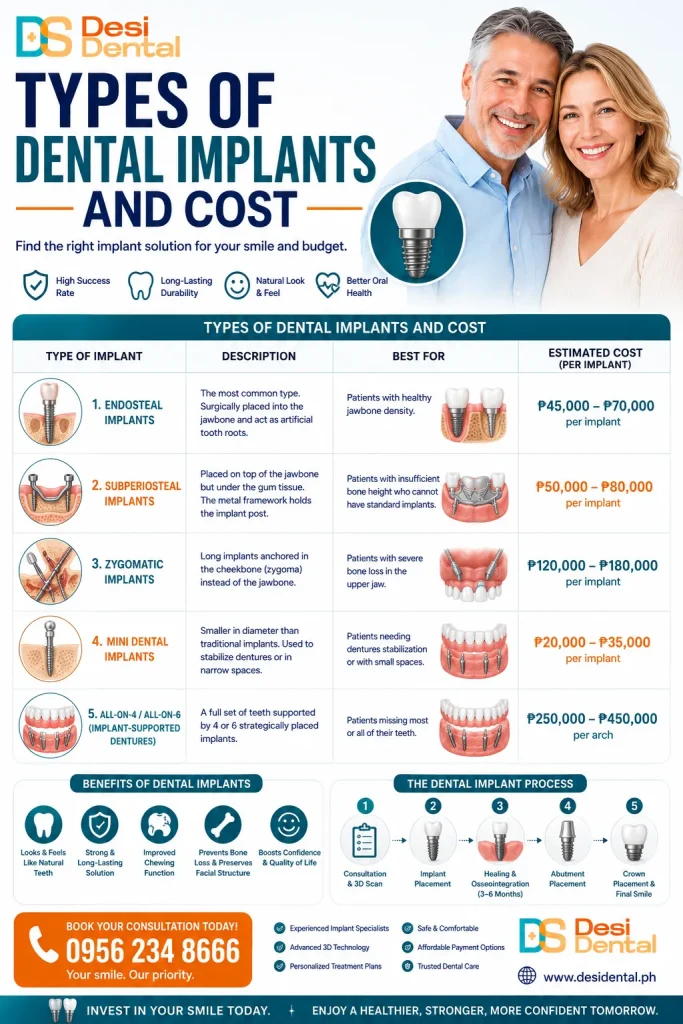
Types of Dental Implants and Cost Comparison Table (2026)
| Type of Implant | Best For | Single Tooth Cost | Full Arch Cost (per jaw) | Success Rate | Treatment Duration | Invasiveness |
|---|---|---|---|---|---|---|
| Endosteal (Standard) | Single to full mouth | $3,800 – $7,500 | $18,000 – $40,000 | 95–98% | 4–8 months | Moderate |
| Subperiosteal | Severe bone loss (lower jaw) | N/A | $15,000 – $28,000 | 90–94% | 3–6 months | Lower |
| Zygomatic | Severe upper jaw bone loss | N/A | $25,000 – $45,000 | 94–96% | 4–7 months | High |
| Mini Implants | Denture stabilization | $1,000 – $2,800 | $6,000 – $13,000 | 85–92% | 1–3 months | Low |
Global Cost Variations
- United States & Canada: Highest costs due to regulations and overhead.
- Europe (Germany, Spain): $2,500 – $5,000 per tooth.
- Mexico & Turkey: Full mouth All-on-4 often $8,000 – $15,000 per arch.
- Vietnam & Thailand: Competitive pricing with improving quality standards.
How to Choose the Right Type and Manage Costs
- Get a comprehensive evaluation with 3D CBCT scan.
- Request detailed treatment plans from 2–3 qualified providers.
- Consider financing options, dental discount plans, or medical loans.
- Ask about phased treatment to spread out payments.
- Prioritize long-term value over cheapest upfront price.
Understanding the different types of dental implants and their costs empowers you to have productive conversations with your dentist and choose a solution that balances quality, longevity, and affordability. While endosteal implants remain the most versatile and reliable for most patients, subperiosteal, zygomatic, and mini implants serve important roles for specific clinical situations.
The best investment is the one that fits your oral health condition, lifestyle, and financial reality. Always consult with an experienced implant dentist or oral surgeon for a personalized assessment.


