

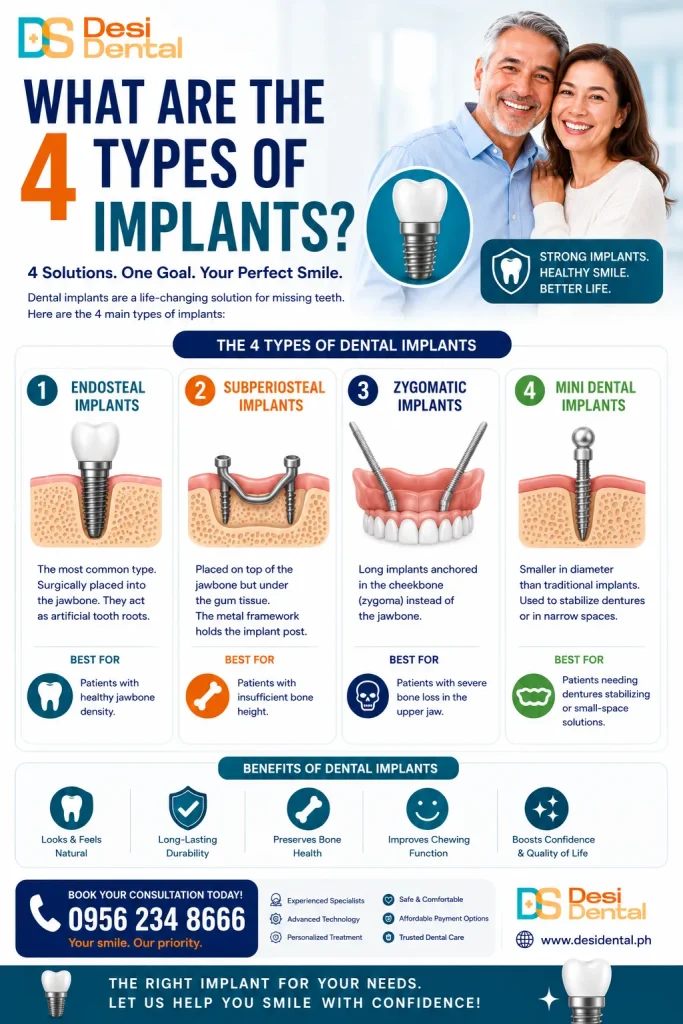
When people search for “What are the 4 types of implants?”, they are looking for clear, practical information to understand their tooth replacement options. In modern implant dentistry, there are four main types of dental implants: Endosteal, Subperiosteal, Zygomatic, and Mini Dental Implants.
Each type has been developed to address different clinical situations, bone conditions, patient needs, and budgets. This comprehensive 2026 guide provides in-depth details on every type — including how they work, ideal candidates, advantages, disadvantages, procedure steps, recovery, success rates, and current cost ranges — so you can make a well-informed decision together with your dentist.
What are the 4 types of implants?
1. Endosteal Implants – The Most Common and Preferred Type
Endosteal implants, also known as root-form implants, are by far the most popular type, accounting for approximately 90-95% of all dental implant procedures performed worldwide.
How They Work: These implants are screw-shaped or cylindrical and are surgically inserted directly into the jawbone. Once placed, they undergo a biological process called osseointegration, where the implant fuses with the living bone over time. After healing, an abutment and crown, bridge, or full prosthesis is attached.
Best For:
- Single missing tooth
- Multiple missing teeth (implant-supported bridges)
- Full arch or full mouth rehabilitation (All-on-4, All-on-6)
- Patients with good to moderate bone density
Advantages:
- Highest long-term success rate (95–98%)
- Excellent stability and chewing force
- Natural appearance and feel
- Helps preserve jawbone density and facial structure
- Versatile for almost any restoration need
Disadvantages:
- Requires sufficient bone volume and density
- Bone grafting may be necessary if bone is insufficient
- Longer overall treatment time (typically 4–8 months)
Procedure & Recovery: The surgery is usually done under local anesthesia or sedation. Healing takes 3–6 months before the final prosthesis is placed. Most patients experience mild swelling and discomfort for 5–10 days.
Cost in 2026:
- Single tooth (implant + abutment + crown): $3,800 – $7,500
- Full arch (All-on-4): $18,000 – $35,000 per arch
2. Subperiosteal Implants
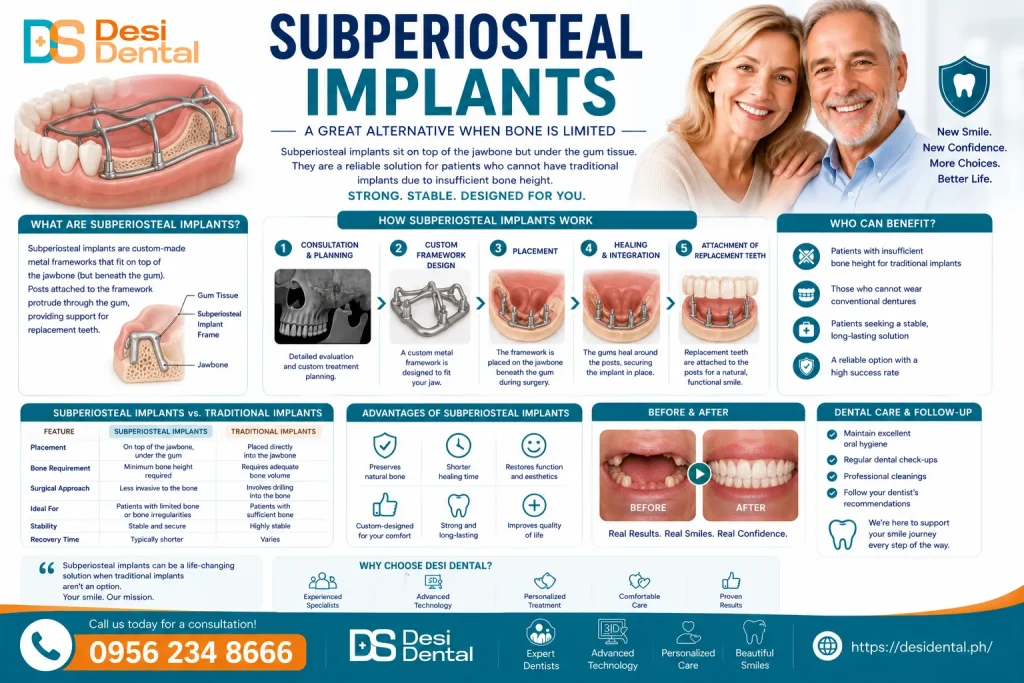
Subperiosteal implants are placed on top of the jawbone but beneath the gum tissue. Instead of going into the bone, a custom metal framework is fabricated to fit the contours of the jawbone, with posts extending through the gums to support the teeth.
How They Work: A 3D scan or impression of the jawbone is used to create a custom-fit titanium framework. This framework is surgically positioned on the bone during a single procedure.
Best For:
- Patients with significant bone loss who do not want or cannot undergo bone grafting
- Primarily used in the lower jaw
- Full arch restorations in cases of shallow bone
Advantages:
- Avoids bone grafting procedures
- Less invasive into the actual bone
- Can be completed faster in suitable candidates
- Suitable for patients with medical conditions that limit bone surgery
Disadvantages:
- Generally less stable and durable than endosteal implants
- Higher long-term complication rates
- Less commonly used today due to improved bone grafting techniques
- Framework may become visible or cause gum irritation over time
Cost in 2026:
- Full arch subperiosteal implant: $15,000 – $28,000 per arch
3. Zygomatic Implants
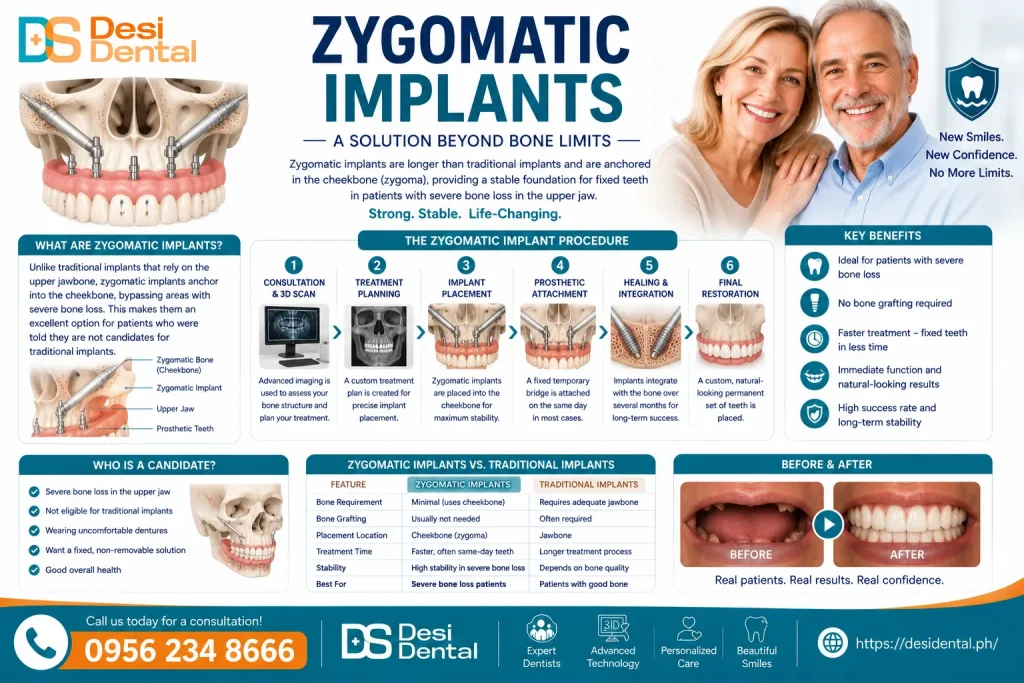
Zygomatic implants are specialized, extra-long implants (35–55mm) that anchor into the dense zygomatic bone (cheekbone) rather than the maxillary (upper) jawbone.
How They Work: These implants are placed at an angle, starting in the upper jaw and extending into the cheekbone for strong anchorage. They are often combined with regular endosteal implants in full upper arch cases.
Best For:
- Patients with severe bone loss in the upper jaw (maxilla)
- Individuals who want to avoid major sinus lift or extensive bone grafting
- Full upper arch or full mouth rehabilitation
Advantages:
- Eliminates or greatly reduces the need for bone grafting
- Frequently allows immediate loading (“Teeth in a Day”)
- High success rate (94–96%) in experienced hands
- Excellent option for complex upper jaw cases
Disadvantages:
- More complex and technically demanding surgery
- Only suitable for the upper jaw
- Requires a highly experienced oral surgeon or implant specialist
- Slightly higher risk of sinus-related complications
Cost in 2026:
- Full upper arch with zygomatic implants: $25,000 – $45,000
- Hybrid cases (zygomatic + endosteal): $30,000 – $55,000
4. Mini Dental Implants (MDIs)
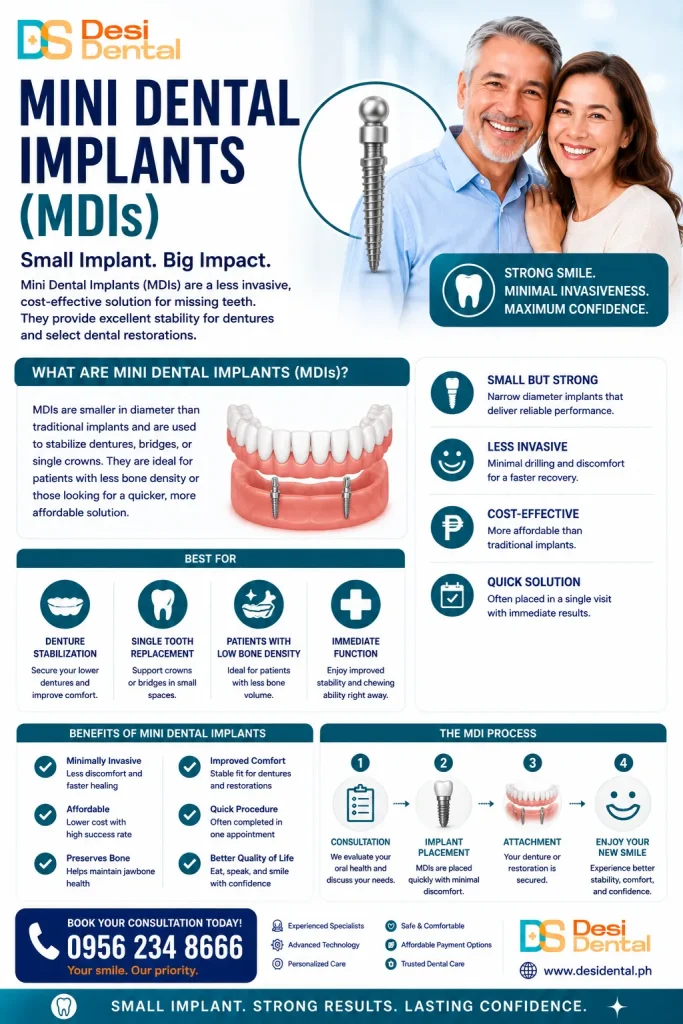
Mini dental implants are narrow-diameter implants (less than 3mm) designed for less invasive treatment.
How They Work: Mini implants are placed directly into the jawbone, often without cutting the gums (flapless technique). They can immediately support dentures or small restorations.
Best For:
- Stabilizing loose lower dentures
- Patients with narrow bone ridges
- Elderly patients or those with health conditions limiting major surgery
- Temporary or transitional tooth replacement
Advantages:
- Minimally invasive procedure
- Often completed in one visit
- Faster healing and recovery
- Significantly lower cost
- Good option for patients who cannot tolerate extensive surgery
Disadvantages:
- Lower strength compared to standard implants
- Higher long-term failure rate under heavy biting forces
- Not recommended for replacing large back teeth as a permanent solution
Cost in 2026:
- Single mini implant: $1,000 – $2,800
- 4–6 mini implants for denture stabilization: $6,000 – $13,000
Detailed Comparison Table: 4 Types of Dental Implants
| Type of Implant | Placement | Best For | Success Rate | Invasiveness | Full Arch Cost (per jaw) | Treatment Time | Bone Requirement |
|---|---|---|---|---|---|---|---|
| Endosteal | Inside jawbone | Most common cases | 95–98% | Moderate | $18,000 – $40,000 | 4–8 months | Moderate-High |
| Subperiosteal | On top of jawbone | Severe bone loss (no graft) | 90–94% | Lower | $15,000 – $28,000 | 3–6 months | Low |
| Zygomatic | Cheekbone (upper) | Severe upper jaw bone loss | 94–96% | High | $25,000 – $45,000 | 4–7 months | Very Low |
| Mini Implants | Inside jawbone | Denture stabilization | 85–92% | Low | $6,000 – $13,000 | 1–3 months | Low |
How to Decide Which Type Is Right for You
The choice depends on several key factors:
- Quantity and quality of remaining jawbone
- Number of missing teeth (single, partial, or full arch)
- Your overall health and medical history
- Budget and insurance coverage
- Desire for immediate results vs staged treatment
- Surgeon’s experience with specific implant types
A detailed consultation with 3D CBCT imaging is essential for accurate diagnosis and personalized recommendations.
The four main types of dental implants — Endosteal, Subperiosteal, Zygomatic, and Mini — allow dentists to successfully treat almost every type of tooth loss situation. Endosteal implants remain the best choice for most patients, while the other types serve as excellent specialized solutions when standard implants are not feasible.
If you are considering dental implants, schedule a consultation with a qualified oral surgeon or implant specialist. They can evaluate your specific condition and recommend the most suitable type for long-term function, comfort, and aesthetics.


