

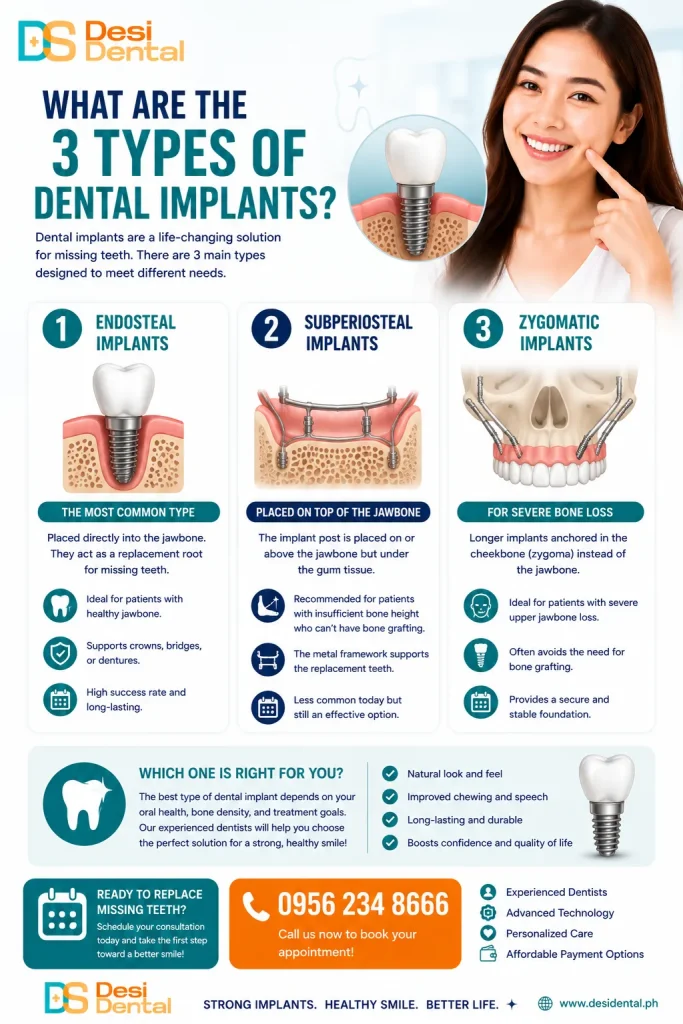
Dental implants have transformed tooth replacement options, offering durable, natural-looking solutions for missing teeth. When people search for “What are the 3 types of dental implants,” they are typically referring to the three primary categories recognized by implant specialists: Endosteal, Subperiosteal, and Zygomatic implants.
Each type is designed for different bone conditions, patient needs, and clinical situations. Understanding these options helps you have more informed discussions with your dentist and choose the best solution for long-term success.
What are the 3 types of dental implants?
1. Endosteal Implants – The Most Common Type
Endosteal implants are by far the most widely used dental implants today, accounting for over 90% of all procedures. Also known as root-form implants, they are shaped like small screws or cylinders and placed directly into the jawbone.
Key Features:
- Made primarily from titanium or zirconia (metal-free option).
- Placed surgically into the jawbone where they fuse with the bone through osseointegration.
- Used for single crowns, bridges, or full-arch restorations.
Who They’re Best For:
- Patients with sufficient healthy jawbone height and density.
- Those seeking the most natural-looking and stable tooth replacement.
Advantages:
- Highest long-term success rate (95–98%).
- Excellent stability and bite force.
- Can support single teeth, multiple teeth, or full dentures.
Disadvantages:
- Requires adequate bone volume. Bone grafting may be needed if bone is insufficient.
Endosteal implants are considered the gold standard for most patients due to their predictability and strength.
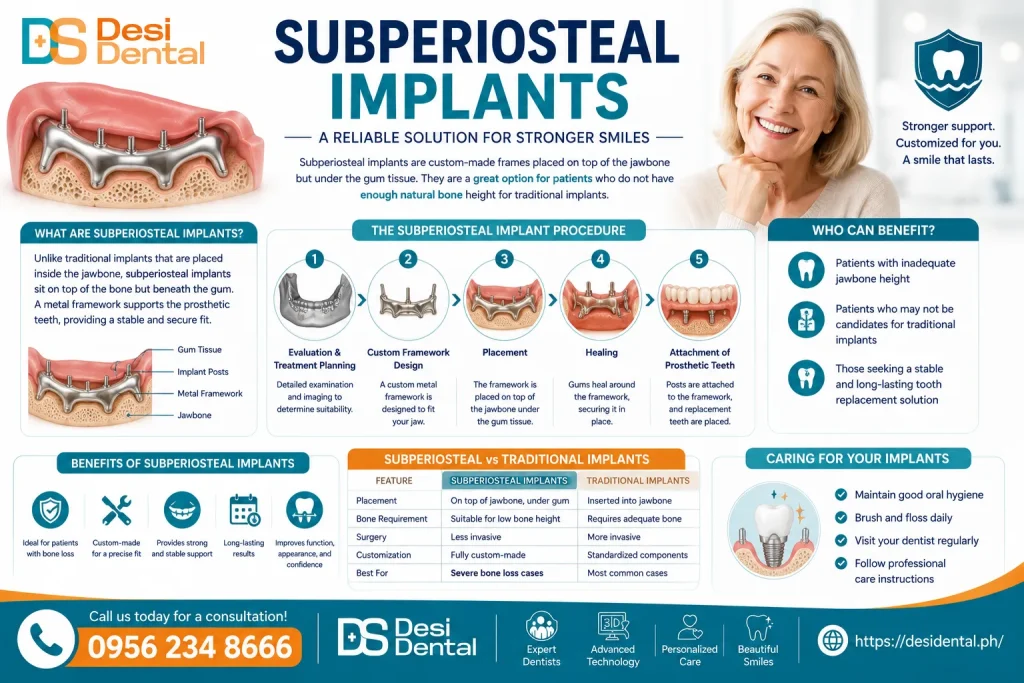
2. Subperiosteal Implants – Ideal for Limited Bone Height
Subperiosteal implants are placed on top of the jawbone but underneath the gum tissue. Instead of being screwed into the bone, they consist of a custom-made metal framework that sits on the bone and supports the prosthetic teeth.
Key Features:
- A metal frame is custom-fitted to the contours of the jawbone.
- Posts protrude through the gums to hold the artificial teeth.
- Less invasive than endosteal implants in cases of bone deficiency.
Who They’re Best For:
- Patients with significant bone loss who cannot or do not want bone grafting.
- Those needing full-arch restoration in the lower jaw.
- Individuals who may not be candidates for endosteal implants.
Advantages:
- Avoids the need for bone grafting procedures.
- Suitable for patients with shallow jawbones.
- Faster placement in some cases compared to grafting + endosteal.
Disadvantages:
- Generally less stable long-term than endosteal implants.
- Higher risk of complications over time.
- Less commonly used today due to advances in bone grafting techniques.
Subperiosteal implants were more popular in the past but are now reserved for specific cases where other options are limited.
3. Zygomatic Implants – Solution for Severe Upper Jaw Bone Loss
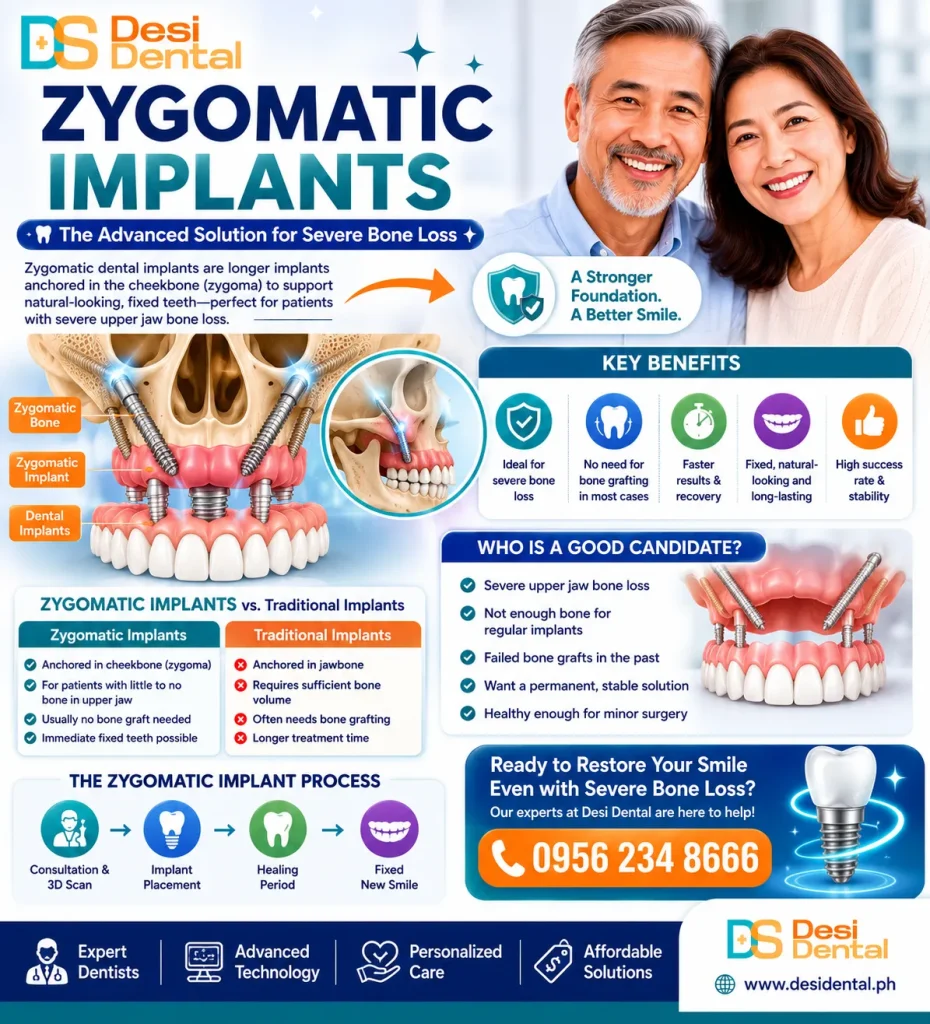
Zygomatic implants are the least common but highly effective for patients with extreme bone loss in the upper jaw. These longer implants anchor into the dense zygomatic bone (cheekbone) rather than the maxillary jawbone.
Key Features:
- Much longer than standard implants (up to 50–55mm).
- Placed at an angle, starting in the upper jaw and extending into the cheekbone.
- Often used in combination with All-on-4 or full-arch concepts.
Who They’re Best For:
- Patients with severe bone atrophy in the upper jaw (maxilla).
- Those who want to avoid major bone grafting or sinus lift procedures.
- Candidates seeking immediate full-arch restoration.
Advantages:
- Eliminates the need for extensive bone grafting.
- Allows for same-day teeth in many cases.
- High success rate in experienced hands (around 95%).
Disadvantages:
- More complex surgical procedure requiring a highly skilled surgeon.
- Limited to upper jaw only.
- Potential for sinus-related complications if not done correctly.
Zygomatic implants have become a game-changer for patients previously told they had “no bone” for traditional implants.
Comparison Table: 3 Types of Dental Implants
| Feature | Endosteal | Subperiosteal | Zygomatic |
|---|---|---|---|
| Placement | Into the jawbone | On top of jawbone | Into cheekbone (upper) |
| Best For | Sufficient bone | Moderate to low bone | Severe upper jaw bone loss |
| Success Rate | 95–98% | Slightly lower | ~95% |
| Invasiveness | Moderate | Lower | Higher |
| Common Use | Single or multiple teeth | Full arch (rare today) | Full upper arch |
| Bone Grafting Needed | Sometimes | Rarely | Usually not |
Which Type of Dental Implant Is Right for You?
The choice depends on several factors:
- Amount and quality of available jawbone
- Overall health and medical history
- Desired timeline (immediate vs. staged treatment)
- Budget and long-term maintenance preferences
A thorough evaluation with 3D CBCT imaging is essential to determine the most suitable option. Modern implant dentistry often combines techniques — for example, using zygomatic implants with endosteal ones for full-mouth rehabilitation.
The three main types of dental implants — Endosteal, Subperiosteal, and Zygomatic — each serve specific clinical needs. Endosteal remains the preferred choice for most patients, while subperiosteal and zygomatic provide valuable alternatives for complex bone-loss cases.
If you’re considering dental implants, consult with an experienced implant specialist or oral surgeon who can evaluate your unique situation and recommend the best solution for long-lasting function and aesthetics.


