

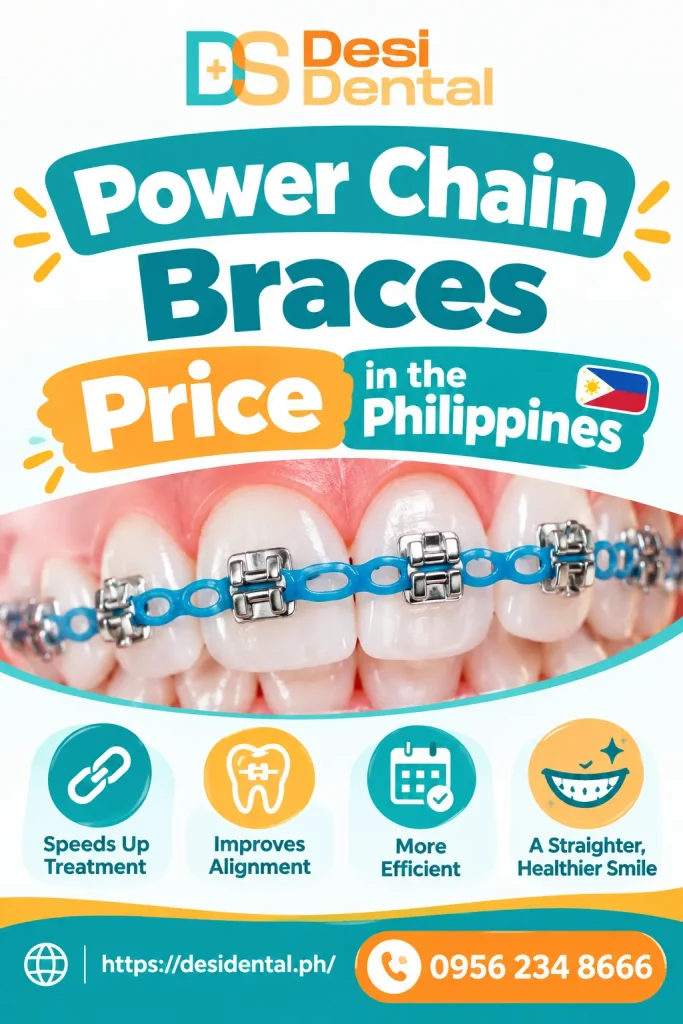
If you are searching for “power chain braces price in the Philippines,” you are probably wondering two things: What exactly are power chains, and how much will the treatment cost?
This guide answers both questions in plain language. It explains what power chains are, why orthodontists use them, how much the full treatment typically costs in the Philippines, what affects the price, and what you can realistically expect as a patient. Everything is written to be clear and useful whether you are a teenager, a parent, or an adult considering braces for the first time.
What Are Power Chains on Braces?
Power chains are not a different type of braces. They are a special kind of elastic used with traditional fixed braces (the ones with metal or ceramic brackets glued to your teeth).
Normally, each bracket is held to the wire by a small single elastic ring called a ligature. A power chain is a long string of these elastic rings connected together, like a chain of rubber bands. Your orthodontist stretches this chain across several brackets so the elastics pull the teeth toward each other with continuous, gentle force.
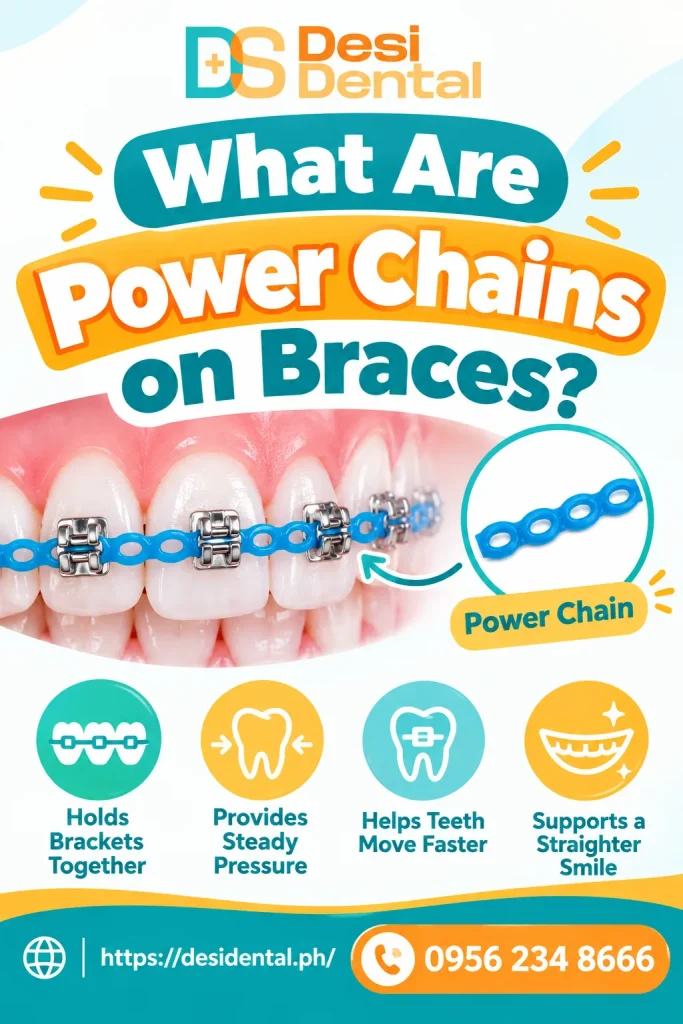
Think of single ligatures as individual rubber bands that simply hold the wire in place. A power chain is like a linked rubber band that actively squeezes teeth closer together while still holding the wire.
Power chains come in three main types:
- Closed (or continuous): The rings are connected with almost no space between them. Used when teeth are already close and need strong, direct closing force.
- Short: Small gaps between the rings. Offers moderate force.
- Long: Wider spacing between rings. Used when teeth are farther apart and gentler force is needed.
They also come in many colors, so you can still choose fun or subtle colors at each adjustment visit.
Why Do Orthodontists Use Power Chains?
Power chains are usually added in the middle or later stages of treatment, not at the very beginning. Their main jobs are:
- Closing spaces left after tooth extractions
- Closing small gaps that open up while teeth are moving
- Correcting uneven spacing between teeth
- Helping finish the final alignment and midline (the center line of your smile)
- Sometimes assisting with rotating a tooth that has not fully responded to the wire alone
They work faster for gap closure than single elastics because the force is continuous and shared across multiple teeth.
Do Power Chains Cost Extra in the Philippines?
In almost every clinic in the Philippines, power chains are treated as a normal part of treatment materials. They are included in the total package price. You will rarely (if ever) see a separate charge for them on your bill.
The actual material is inexpensive for clinics. Dental supply stores sell power chain rolls or pre-cut strands for roughly ₱35 to ₱400 depending on length, brand, and type. Clinics simply include this cost inside the overall treatment fee or monthly adjustment fee.
So when people search for the price of “power chain braces,” what they really need is the cost of traditional braces treatment that may use power chains.
Power Chain Braces Price in the Philippines 2026
Prices below are typical full-treatment ranges for both upper and lower teeth. They usually cover the brackets, wires, all regular adjustments, power chains when needed, and basic retainers at the end. Always confirm the exact inclusions with the clinic.
| Type of Braces | Typical Price Range (₱) | Average Treatment Time | Best For |
|---|---|---|---|
| Traditional metal braces | 30,000 – 80,000 (up to 100,000 in some clinics) | 18–24 months | Most patients, budget-friendly, power chains commonly used |
| Ceramic (tooth-colored) braces | 50,000 – 140,000 | 18–24 months | Patients who want less visible braces |
| Self-ligating (Damon or similar) | 90,000 – 150,000 | 12–20 months | Faster treatment, fewer visits |
| Lingual braces (behind teeth) | 80,000 – 200,000 | 18–30 months | Complete invisibility from the front |
| Clear aligners (Invisalign etc.) | 120,000 – 300,000+ | 12–18 months | Mild to moderate cases, removable option |
Regional differences matter:
- Metro Manila (especially Makati, BGC, Ortigas, Quezon City) tends to be 10–30% higher because of higher clinic operating costs.
- Cebu, Davao, Iloilo, and provincial cities are usually more affordable.
- Some clinics outside major cities offer metal braces packages starting closer to ₱30,000–45,000.
What Is Usually Included in the Price?
A good package typically covers:
- Initial consultation and diagnostic records (X-rays, photos, models or digital scans)
- Placement of brackets and first wires
- All regular adjustment visits (including power chain changes)
- Emergency repairs for broken brackets or wires
- Removal of braces at the end
- One set of retainers (fixed, removable, or both)
Items that may cost extra:
- Tooth extractions
- Temporary anchorage devices (mini-screws)
- Advanced imaging or 3D scans beyond basic records
- Premium retainers or replacement retainers
- Whitening after treatment
Power Chain Braces at Desi Dental
Desi Dental is a dental clinic with branches in Quezon City and San Juan. They offer traditional braces treatment that may include power chains when needed to close gaps between teeth.
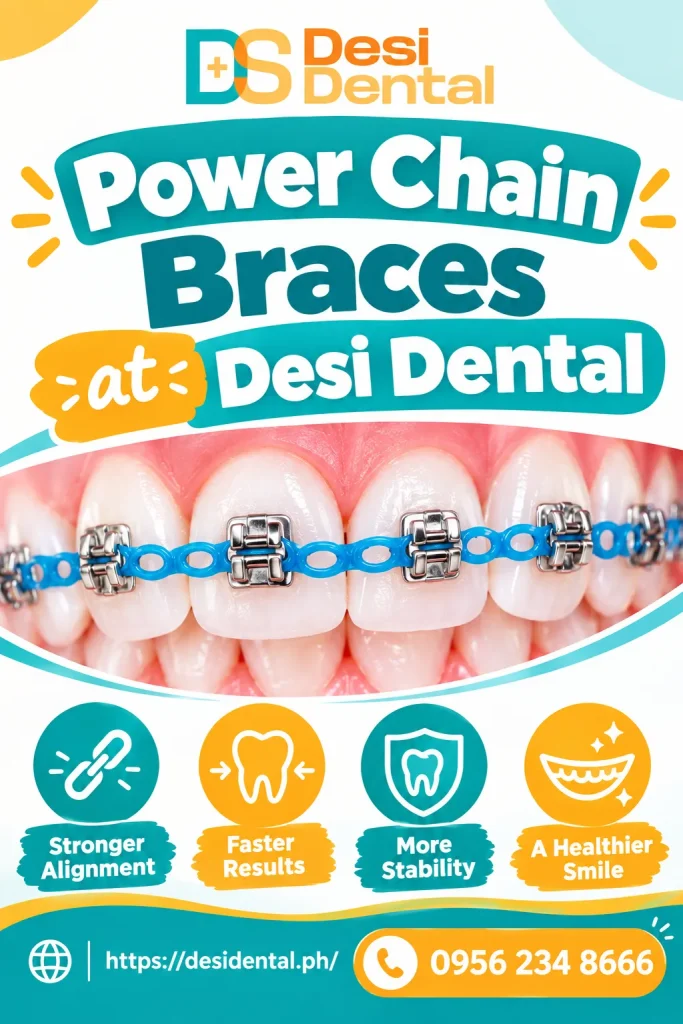
Power chains are elastic chains used during orthodontic treatment to help move teeth more effectively. At Desi Dental, these are part of the standard braces process handled by their orthodontic team.
The clinic provides personalized consultations to assess each patient’s needs and recommend the most suitable treatment plan.
What Happens During Treatment When Power Chains Are Used
- Early phase – Brackets and wires are placed. Teeth start aligning. Single elastics are usually used.
- Mid-to-late phase – Once teeth are roughly in position, the orthodontist switches to power chains to close remaining gaps.
- Adjustment visits – Power chains are typically changed every 4–6 weeks. You may feel pressure or mild soreness for 1–3 days after each change (similar to a normal adjustment).
- Finishing – Once spaces are closed and teeth are well aligned, power chains are removed and final detailing wires are used.
- Retention – Braces come off and retainers begin.
Most patients wear power chains for several weeks to a few months, not the entire treatment.
Pain, Comfort, and Daily Life with Power Chains
- The first 24–72 hours after placement or replacement can feel tighter and more sore than regular elastics.
- Over-the-counter pain relievers (as advised by your orthodontist) and soft foods help.
- Power chains can trap food more easily, so thorough brushing and flossing (or using interdental brushes and water flossers) becomes even more important.
- Speech is rarely affected because the chains sit on the front of the brackets like normal elastics.
- You can still eat most foods, but continue avoiding very hard, sticky, or chewy items that can break brackets or stretch the chain.
Frequently Asked Questions
Do power chains make treatment faster?
They can speed up the gap-closing phase, which may shorten overall treatment time for some patients, but the biggest factors remain case complexity and how well you follow instructions.
Can I request power chains early?
Your orthodontist decides when they are needed. Using them too early is not helpful and can sometimes cause problems.
Are colored power chains more expensive?
No. Color choice does not affect the price.
What if I lose or break a power chain?
Contact the clinic. Most packages cover emergency repairs.
Is the price the same for teenagers and adults?
The base price is similar, but adult cases are sometimes more complex and may take longer or cost more.
Power chains themselves add almost nothing to the cost of braces in the Philippines. They are a normal tool used during traditional fixed-brace treatment, especially when spaces need to be closed.
For most people, the realistic budget for treatment that may involve power chains is the cost of traditional metal braces — typically ₱30,000 to ₱80,000 for a complete package, with higher amounts for ceramic or more advanced systems. Prices in Metro Manila run higher than in other cities, and payment plans make the treatment more manageable for many families.


