
Subperiosteal dental implants provide an effective, graftless solution for individuals facing significant jawbone atrophy who are not ideal candidates for traditional endosteal implants. These custom-designed implants rest on top of the jawbone beneath the gum tissue (periosteum), offering stable support for replacement teeth without the need for invasive bone grafting procedures.
In recent years, advancements in CAD/CAM technology, 3D printing (additive manufacturing), and high-resolution CBCT imaging have revitalized subperiosteal implants, delivering superior precision, better fit, and improved long-term outcomes compared to older designs.
What Are Subperiosteal Dental Implants?
Subperiosteal implants consist of a custom-fabricated metal framework, typically made from biocompatible titanium or titanium alloys. The framework sits directly on the alveolar ridge of the jawbone but under the periosteum. Multiple transmucosal posts protrude through the gums to anchor crowns, bridges, or full-arch prostheses.
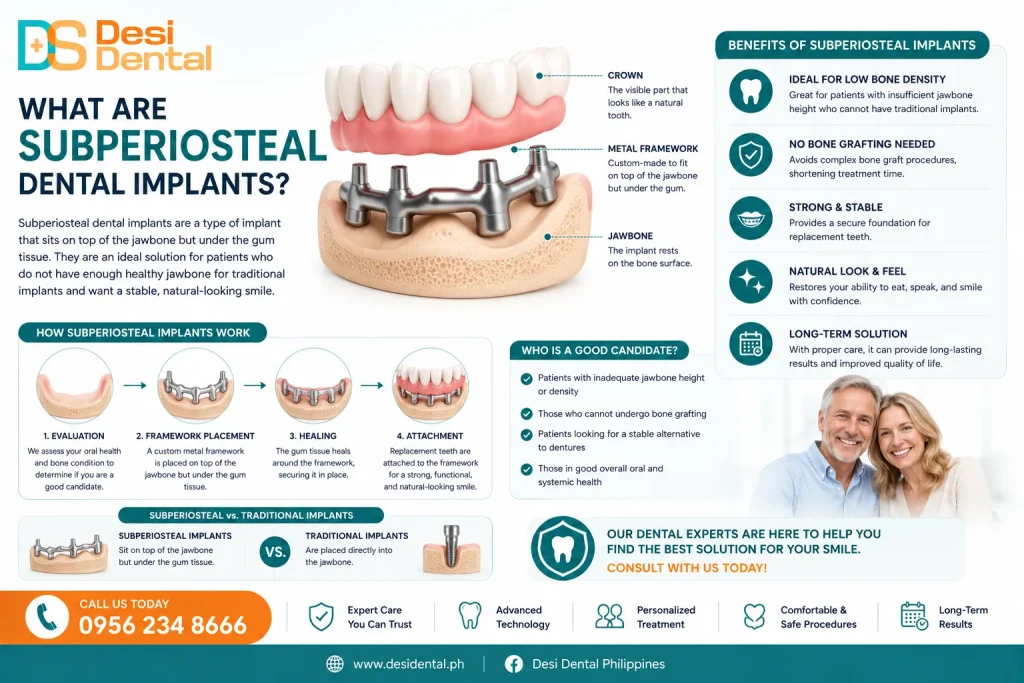
Unlike endosteal implants, which are screw-like posts inserted directly into the bone, subperiosteal implants distribute load across a broader surface area. This makes them particularly suitable for patients with insufficient bone height, width, or density. Modern versions use digital workflows for millimeter-level accuracy, significantly reducing historical complications like poor fit or framework mobility.
Brief History and Modern Revival
Subperiosteal implants date back to the 1940s but experienced high failure rates in earlier decades (often due to imprecise casting methods and infections). Today, they represent a renaissance in implant dentistry. Digital technologies—CBCT scans, sophisticated CAD software, and direct metal laser sintering (DMLS) 3D printing—enable patient-specific designs that adapt perfectly to individual anatomy, leading to survival rates often exceeding 90-97% in contemporary studies.
Ideal Candidates for Subperiosteal Dental Implants
You may be a strong candidate if you experience:
- Severe mandibular or maxillary bone resorption from long-term denture wear, periodontal disease, trauma, or aging.
- Inadequate bone volume for conventional implants, even after considering grafting.
- Medical conditions (e.g., uncontrolled diabetes, osteoporosis, or history of radiation therapy) that increase risks associated with bone grafting.
- Desire to avoid multiple surgeries or extended healing periods.
- Need for full-arch rehabilitation in atrophic jaws.
A comprehensive evaluation, including 3D CBCT imaging and medical history review, is essential to determine suitability.
The Subperiosteal Dental Implants Procedure
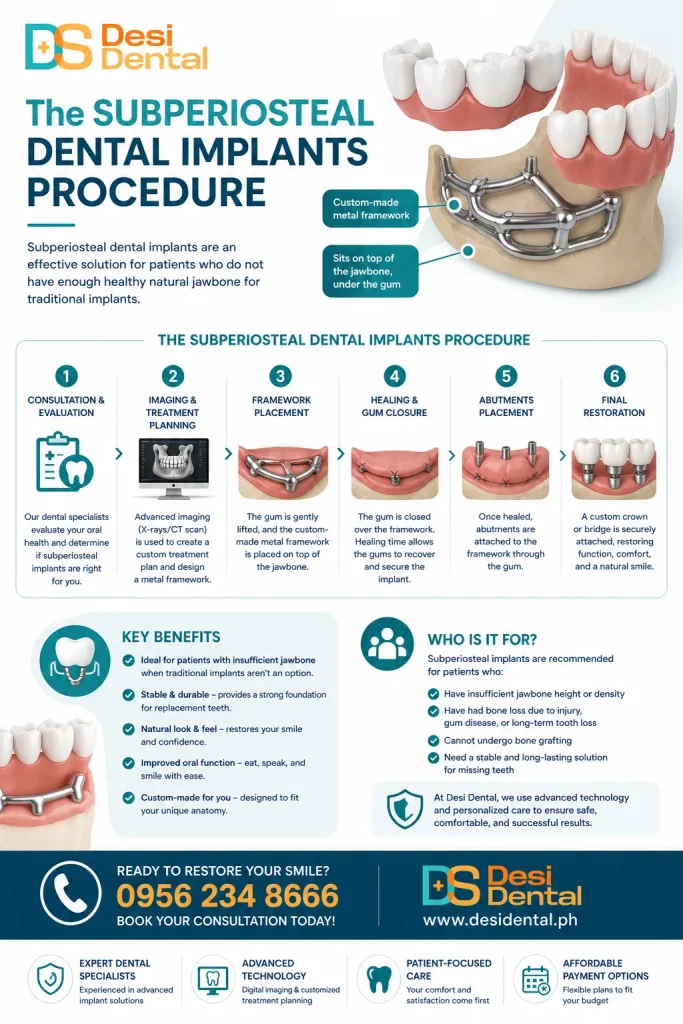
- Initial Consultation and Digital Planning — Detailed clinical exam, impressions, and CBCT scans create a precise 3D model of your jaw. The implant framework is designed virtually for optimal fit and biomechanics.
- Custom Fabrication — Using CAD/CAM and 3D printing, the titanium framework is manufactured with high precision, often including strategic fixation points or surface treatments for better soft tissue integration.
- Surgical Placement — Performed under local anesthesia or sedation, the surgeon makes an incision to expose the bone, positions the framework securely (sometimes with fixation screws), and sutures the gums around the protruding posts. The procedure is typically less invasive to the bone itself and can take 1-2 hours.
- Healing and Prosthetic Attachment — Initial healing occurs over weeks to months. Many modern cases allow for early or immediate loading of provisional prostheses. Final restorations (crowns or dentures) are placed once tissues stabilize, often within 3-6 months total treatment time.
Key Benefits of Subperiosteal Dental Implants
- No Bone Grafting Required — Eliminates donor site morbidity, additional surgeries, and months of waiting for graft integration.
- Shorter Overall Treatment Timeline — Faster path to functional teeth for patients with severe atrophy.
- Customized Precision and Comfort — Superior adaptation reduces pressure points and improves stability.
- High Patient Satisfaction — Restores chewing, speech, and aesthetics effectively, even in challenging cases.
- Preservation of Remaining Bone — Distributes forces more evenly in some designs.
- Viable for Full-Arch Restorations — Excellent option for complete edentulism.
Modern survival rates are reported between 90-97% at 5+ years with proper case selection and care.
Potential Risks and Complications
While safer than older iterations, risks include:
- Infection or peri-implantitis around posts.
- Framework exposure due to gum recession.
- Implant mobility if oral hygiene is inadequate or in cases of ongoing bone resorption.
- Higher initial cost and surgical complexity compared to standard implants.
- Need for experienced surgeons specializing in advanced implantology.
Meticulous oral hygiene and regular professional maintenance are critical for long-term success.
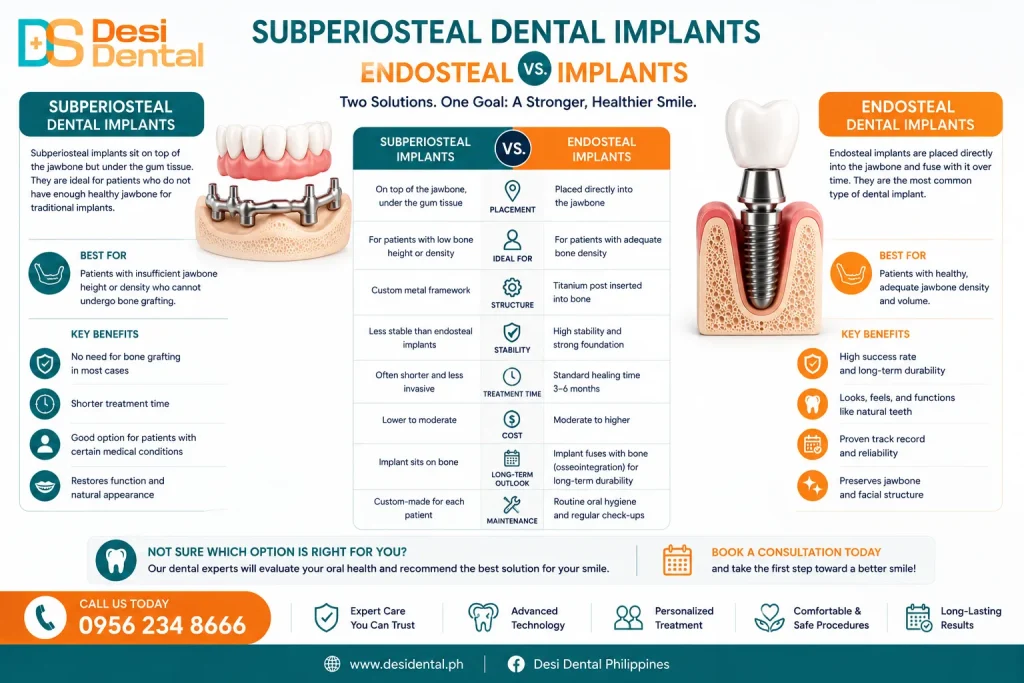
Subperiosteal Dental Implants vs. Endosteal Implants
| Aspect | Subperiosteal Implants | Endosteal Implants |
|---|---|---|
| Placement | On top of jawbone, under gums | Screwed directly into jawbone |
| Bone Requirement | Minimal; ideal for severe atrophy | Requires adequate bone height & density |
| Bone Grafting | Usually not needed | Frequently required |
| Customization | Fully patient-specific (CAD/CAM + 3D print) | Standard sizes with some customization |
| Treatment Time | Often shorter overall | Longer if grafting involved |
| Invasiveness | Less bone drilling | More invasive to bone |
| Success Rate (Modern) | 90-97% at 5 years | 95%+ at 5-10 years |
| Best For | Severe bone loss cases | Patients with good bone volume |
Recovery and Aftercare
Recovery is generally manageable. Expect swelling, soreness, and dietary restrictions (soft foods) for the first 1-2 weeks. Most patients return to normal activities within days to a week. Full osseous adaptation and prosthetic finalization take 3-6 months.
Long-term maintenance includes:
- Gentle brushing around posts with soft brushes or water flossers.
- Antimicrobial rinses as recommended.
- Biannual dental visits for professional cleaning and monitoring.
- Avoiding smoking and managing systemic health conditions.
With excellent care, these implants can last 10-15 years or longer.
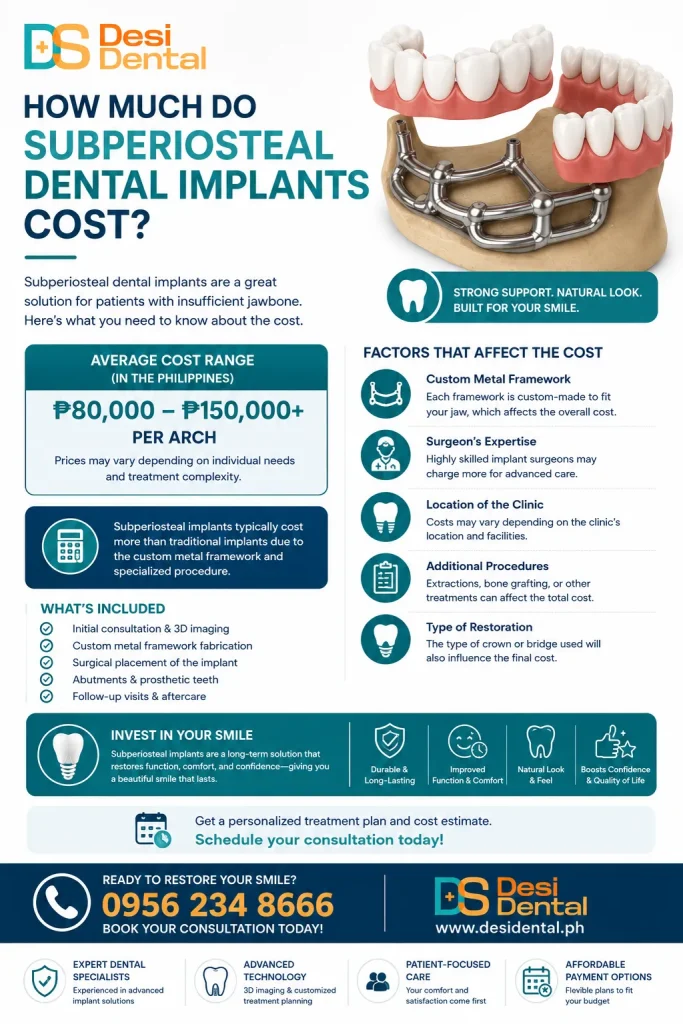
How Much Do Subperiosteal Dental Implants Cost?
Subperiosteal implants are typically more expensive than standard endosteal options due to customization and expertise required. Costs vary widely by location, case complexity, and number of units but often range higher than conventional implants. Many patients find the investment worthwhile given the avoidance of grafting and faster results. Consult your provider for a personalized quote and financing options.
Frequently Asked Questions
Are subperiosteal implants painful? The surgery is performed with anesthesia, and post-operative discomfort is usually controlled with medication. Most describe it as less intense than expected.
How long do they last? With proper care, 10-15+ years is common, and modern designs show strong longevity.
Can they support full mouth restoration? Yes, they are highly effective for full-arch fixed or removable prostheses.
Are there alternatives? Yes, including zygomatic implants, bone grafting with endosteal implants, or traditional dentures. Your specialist will recommend the best based on your anatomy.
Subperiosteal dental implants have evolved into a reliable, innovative option for restoring confidence and function in patients with severe bone loss. Thanks to digital precision and advanced materials, they offer predictable results without the drawbacks of older techniques.
If you’ve been told you lack sufficient bone for implants or want to avoid grafting, consult a qualified oral surgeon or implant specialist experienced in subperiosteal techniques. A thorough 3D evaluation will provide clear answers tailored to your situation.